
Endpoint Protection vs Antivirus: Which is better for U.S. businesses in 2026?
In the fast-expanding digital world of 2026, the question for American corporations is no longer, “Do we have security?” but “Is our security fast enough to stop an AI-driven attack?” As the United States remains the primary target of global cybercrime—accounting for over 93% of all recorded incidents in the Americas—the debate over Endpoint Protection (EPP/EDR) and Legacy Antivirus (AV) has heated up.
With the average cost of a data breach in the USA now hovering around $4.88 million, choosing the wrong defense isn’t just a technical oversight; it’s a massive financial risk.
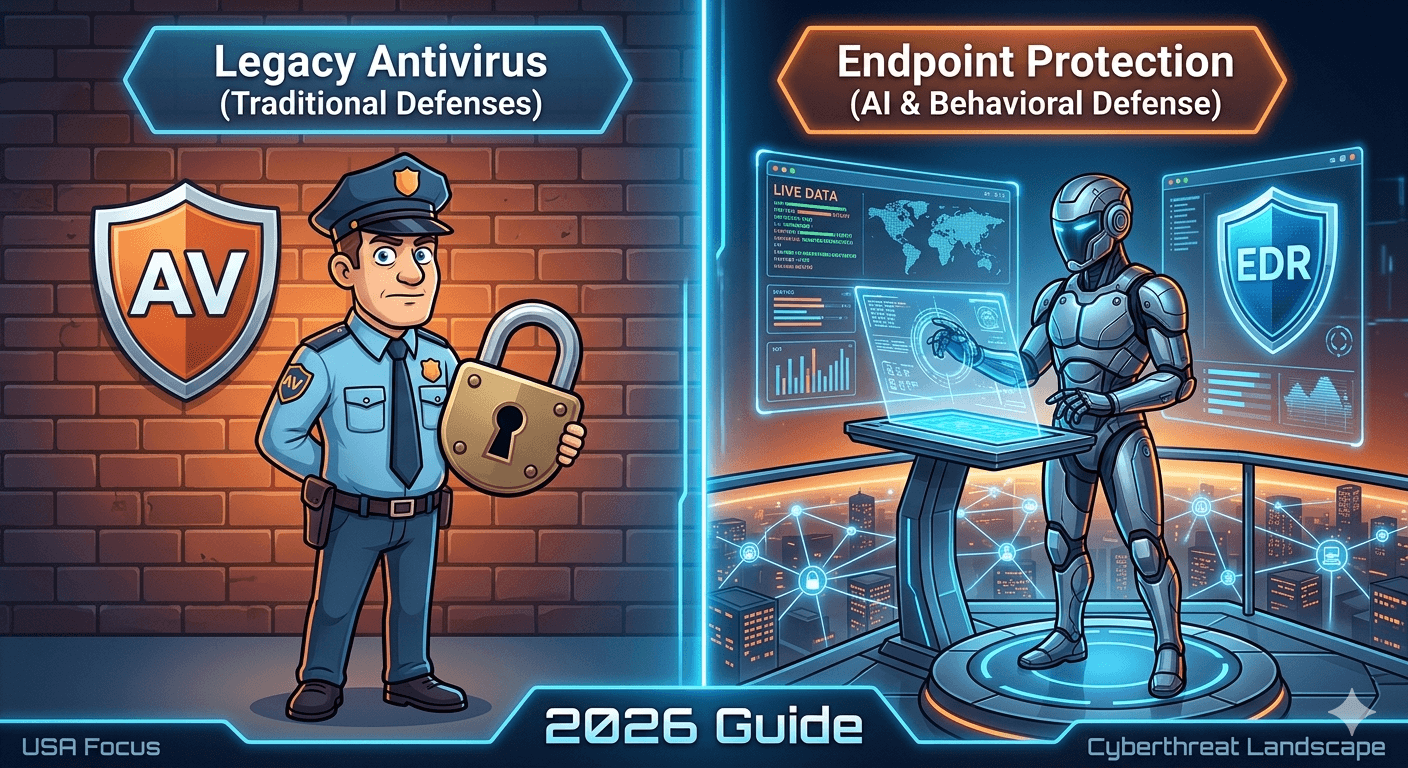
The Core Difference: Security Guard vs. Surveillance System
To understand which is better, we must first define what they actually do in the context of 2026 threats.
What is Antivirus (AV)?
Think of traditional antivirus as a security guard at a gate with a “Most Wanted” list. It uses signature-based detection, meaning it scans files and compares them against a database of known threats. If a file matches a “fingerprint” in the database, the AV blocks it.
- Best for: Detecting “commodity” malware and known viruses.
- The Flaw: It is purely reactive. If a hacker creates a brand-new “Zero-Day” virus or uses “fileless” malware that lives only in the computer’s memory, the AV guard won’t recognize it because it isn’t on the list.
What is Endpoint Protection (EDR/XDR)?
Endpoint Protection is more like a high-tech surveillance system with AI-driven behavioral analytics. It doesn’t just look at what a file is; it watches what the file does. If a legitimate-looking program suddenly starts encrypting files or trying to connect to a suspicious server in Eastern Europe, the system flags the behavior as malicious and shuts it down instantly.
- Best for: Stopping ransomware, fileless attacks, and sophisticated “living-off-the-land” (LotL) techniques.
- The Advantage: It provides “The Big Picture,” securing the entire network and providing forensic data to show exactly how a hacker tried to get in.
2026 Cybersecurity Trends: Why the USA is Shifting
The 2026 threat landscape in the USA has undergone three major shifts that make traditional AV increasingly obsolete for businesses.
1. The Rise of “Polymorphic” and AI-Generated Malware
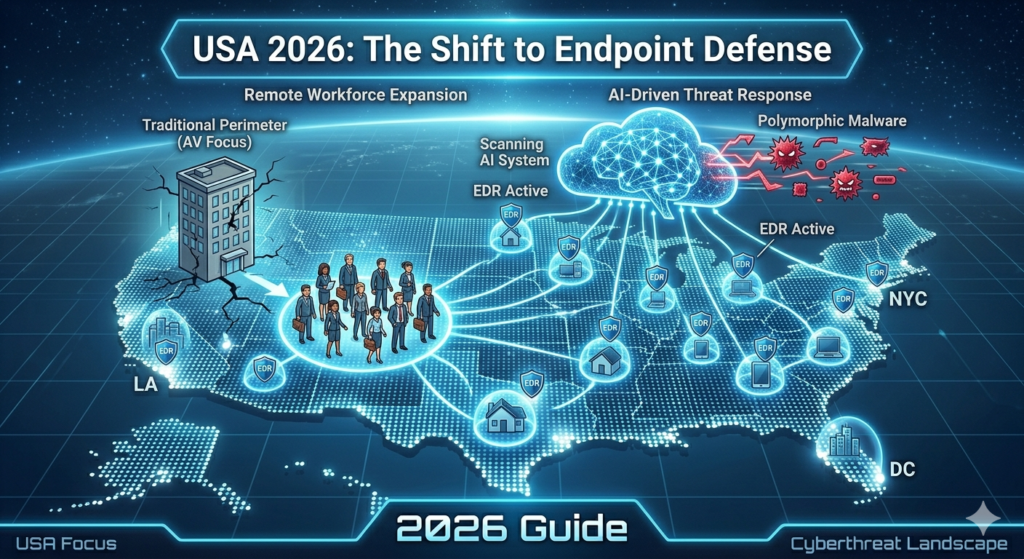
Hackers are now using AI to rewrite malware code every few seconds. Because the “signature” of the file changes constantly, traditional antivirus cannot keep up. In fact, 2026 data suggests that legacy AV now misses approximately 40% of modern attacks.
2. The Remote and Hybrid Work Reality
With a massive portion of the U.S. workforce operating from home, the “office perimeter” has vanished. Employees are using home Wi-Fi and personal devices (BYOD), creating billions of new “endpoints.” Endpoint Protection platforms are designed to secure these scattered devices through the cloud, whereas old-school AV often struggles to provide centralized visibility.
3. Ransomware 3.0: Data Theft & Extortion
In 2026, ransomware isn’t just about locking your files. Attackers now steal sensitive data first (exfiltration) and then threaten to leak it. Endpoint Protection (specifically EDR) can detect the unusual data movement associated with theft, whereas Antivirus only triggers once the encryption (the final step) begins. CISA’s Official Ransomware Prevention Guide
Comparison at a Glance: AV vs. Endpoint Protection
| Feature | Legacy Antivirus (AV) | Endpoint Protection (EDR/EPP) |
| Primary Method | Signature-based (Looks for known files) | Behavioral Analysis (Looks for actions) |
| Response | Quarantines or deletes a file | Isolates the device, rolls back changes |
| Visibility | Isolated to the specific device | Network-wide forensic visibility |
| Threat Hunting | No | Yes (Proactive searching for threats) |
| Complexity | Low (Set and forget) | Moderate (Requires some monitoring) |
| 2026 Market Cost | $30–$100 per year (Individual) | $5–$30 per month/user (Business) |
The Verdict: Which Is Better for You?
The “better” choice depends entirely on who you are and what you are protecting.
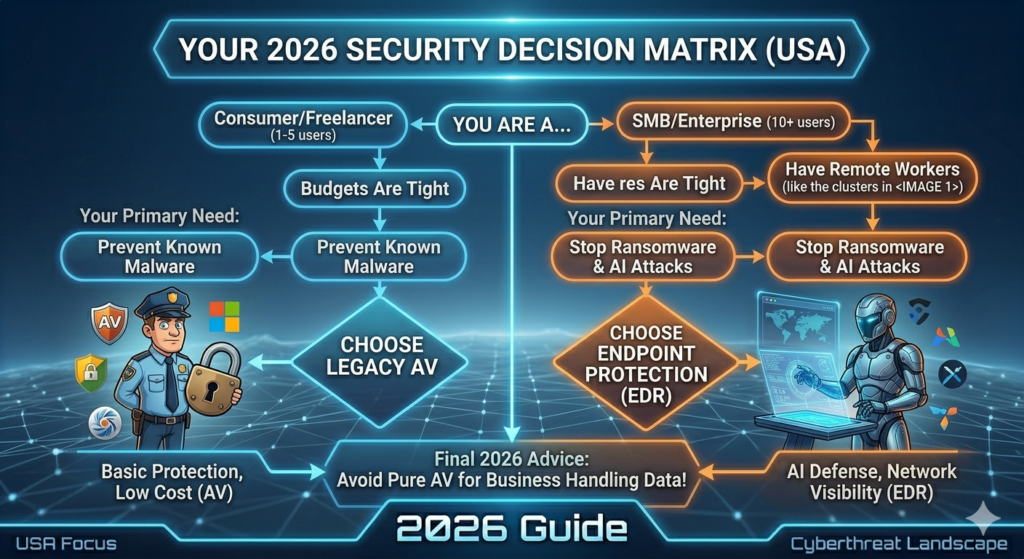
Case A: You are an Individual or a Very Small Business (1–5 Employees)
If you are a freelancer or a tiny shop with limited sensitive data, Modern Next-Gen Antivirus (NGAV) might be enough. Brands like Bitdefender, Norton Small Business, or ESET have integrated basic behavioral elements into their 2026 suites. They are affordable and don’t require a dedicated IT person to manage.
Case B: You are a U.S. Business with 10+ Employees or Remote Workers
For any business handling customer data, HIPAA-regulated info, or financial records, Endpoint Protection is the only viable choice.
In 2026, the standard for U.S. enterprises is the Endpoint Protection Platform (EPP), which combines antivirus with Endpoint Detection and Response (EDR). Leaders in this space for 2026 include:
- CrowdStrike Falcon: The “Gold Standard” for speed and AI-driven prevention.
- SentinelOne: Famous for its “One-Click Rollback” feature that can undo ransomware encryption.
- Microsoft Defender for Endpoint: A top choice for companies already deep in the Azure/Microsoft 365 ecosystem.
- Sophos Intercept X: Highly rated for its ease of use for mid-market American firms.
Cost Analysis in the USA (2026)
Budgeting for security has changed. While AV was a one-time annual purchase, Endpoint Protection is usually a “Security-as-a-Service” subscription.
- Antivirus Costs: Expect to pay between $35 and $80 per year per device for premium consumer/small business versions.
- Endpoint Protection Costs: Entry-level EDR (like CrowdStrike Falcon Go) starts around $59.99 per device annually. Mid-tier enterprise solutions with 24/7 monitoring (MDR) can range from $150 to $200 per device annually.
While EDR is more expensive, the ROI is found in avoiding the $4.88 million average breach cost. [ IBM Cost of a Data Breach Report 2025-2026 ] One prevented ransomware incident pays for the software for a lifetime.
Conclusion: Don’t Bring a Knife to a Gunfight
In 2026, hackers are using autonomous AI agents to probe your network for weaknesses. Relying solely on a signature-based Antivirus is like trying to stop a modern burglar with a 1990s padlock.
For the American business owner, Endpoint Protection is no longer a luxury—it is a baseline requirement. If your current “antivirus” hasn’t been updated to an EDR/XDR model, your endpoints are likely the weakest link in your company’s survival.